Alpha Futures Collapsed in 24 Hours. The Data Saw It Coming Days Earlier

Prop firm crisis management just got its clearest case study of 2026, at a moment when 72% of repeat buyers say they permanently abandon a brand after a single trust-breaking incident, with slow or dishonest crisis communication cited as the top cause in 54% of those cases (Source: Qualtrics XM Institute).

At Alpha Market Flow, we monitor sentiment across the prop trading industry daily, and the week Alpha Futures unraveled, our data told the story before the headlines did. Small pockets of negative sentiment appeared days before the firm lost its platforms, closed a flagship plan, and watched review sites delist it within hours.

This article walks through what our monitoring showed, how the crisis cascaded, and the detection and response playbook every prop firm founder should take from it.

Previous Article
Next Article

Chapters

Key Takeaways

  • Negative sentiment spikes appeared days before the Alpha Futures crisis went public.
  • Platform loss, plan closure, and payout disputes hit within a single 24-hour window.
  • Review sites and aggregators delisted the firm the same day the news broke.
  • Alpha Market Flow builds prop firm crisis management around early detection, not damage control.
  • Response speed decides recovery. Monitoring decides whether you get to respond early.

What Happened at Alpha Futures

On July 12, 2026, Alpha Futures announced that NinjaTrader had terminated its contract with the firm, ending access to NinjaTrader and Tradovate, the two most widely used platforms in futures prop trading. The fallout was immediate and public.

Based on the firm's announcements and widespread industry reporting:

  • The Premium plan, which the firm acknowledged was losing money, was discontinued outright.
  • Active Premium accounts were closed and refunded, and traders reported that earned, pending payouts were converted into refunds of the account fee instead.
  • Remaining accounts were pushed to migrate to the firm's newer in-house platform, which traders had already publicly criticized.
  • Review sites and affiliate aggregators began delisting the firm within a single day, citing the payout dispute as their reason.
  • Traders publicly reported pending payouts in the five figures replaced by refunds worth a fraction of that amount.

Whether Alpha Futures survives is still an open question, and we are not here to speculate on it. What matters for every other operator is the shape of the collapse. Trust did not erode gradually. It snapped, in public, in about 24 hours. That pattern is exactly what our prop firm trust playbook warned about: payout disputes are the single fastest trust destroyer in this industry.

The Warning Signs Were Visible Days Before

Here is the part most founders miss. We pulled net sentiment data on Alpha Futures for the week of July 7 through July 14, and the chart tells a story in two acts.

Looking at the data:

  • From July 7 through July 11, sentiment was mostly positive, but with repeated sharp dips into negative territory. Short, deep spikes of complaint that recovered quickly.
  • These were not random noise. Traders were already posting about payout delays and platform friction. Each red spike was a real grievance reaching public channels.
  • Starting late on July 12, the pattern inverted. Negative sentiment stopped recovering. The dips became sustained troughs, and by July 13 and 14, negative conversation dominated.
  • The positive spikes that remained were largely defensive posts and official communications fighting a losing share-of-voice battle.

In other words, the crisis did not begin when the announcement dropped. It began days earlier, in scattered complaints that most firms would have dismissed as background noise. A

firm watching its PR intelligence signals would have seen the frequency and depth of those red spikes increasing and asked why, while there was still time to act.
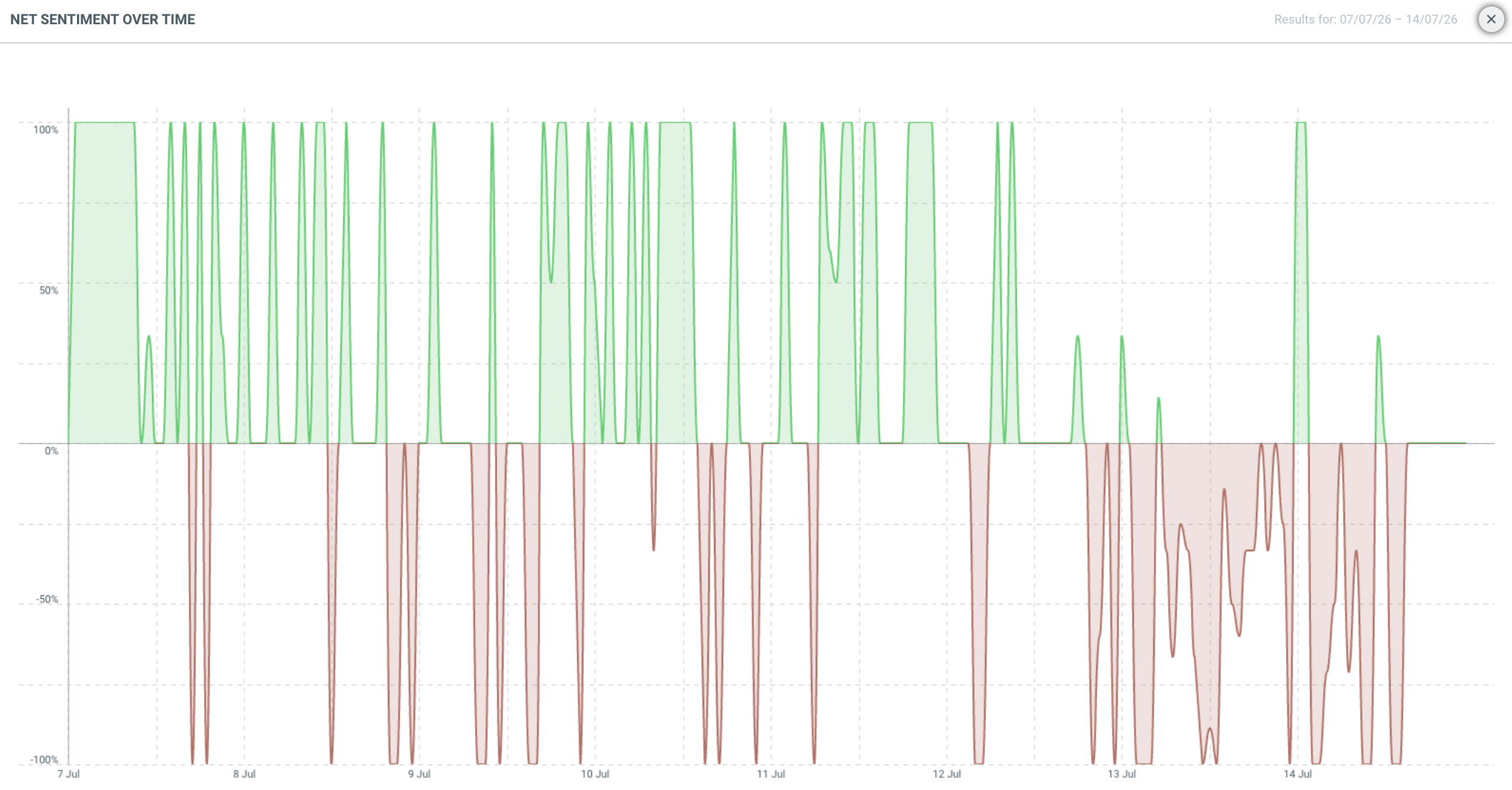
Alpha Futures Net Sentiment Before and After Crisis

Why Small Pockets of Negative Sentiment Matter

A single bad review is an anecdote. A cluster of them, accelerating in frequency, is a signal. The difference between the two is measurement, and it is the foundation of prop firm crisis management done properly.

Here is what early negative sentiment clusters typically indicate in prop trading:

  • Operational strain going public. Payout delays, support backlogs, and platform outages get discussed on X and Discord before they ever reach your dashboard.
  • Affiliate and reviewer doubt. The people who list and recommend firms watch these channels obsessively. They start hedging their coverage before they delist.
  • Community narrative formation. Traders compare notes fast. Once three or four people connect the same complaint, a narrative exists, and narratives spread faster than facts.
  • A shrinking response window. Reputation research shows complaints now reach mass audiences in hours, not days. Every unanswered spike compounds.

The red pockets before a crisis are the cheapest problems you will ever fix. The same issues, one week later, cost platforms, listings, and revenue. This is why we treat sentiment monitoring as conversion infrastructure, not vanity reporting, across our prop firm marketing engagements.

Want to see what your firm's sentiment data looks like right now? Schedule a call with Alpha Market Flow and we will walk you through it.

How the Crisis Cascaded: Platforms, Payouts, Delistings

Once the announcement hit, three separate failure modes reinforced each other. Understanding the cascade matters because each stage was survivable on its own. Together, they were not.

The cascade looked like this:

  • Platform loss removed the product. Losing NinjaTrader and Tradovate meant the core trading experience most customers signed up for no longer existed.
  • The payout decision removed the trust. Refunding account fees instead of paying earned withdrawals confirmed the exact fear every trader carries: that the rules change when it is time to get paid.
  • Delistings removed the distribution. Aggregators and review sites are where traders shortlist firms. Being pulled from them cuts off new challenge sales at the source, which is why we tell founders that comparison site presence is a growth asset you have to defend, not just win once.
  • The story wrote itself. With no proactive narrative from the firm filling the gap in those first hours, reviewers, affiliates, and traders wrote the story instead.

Each stage amplified the next. The platform news made traders check their payouts. The payout complaints made reviewers check their listings. The delistings made the story credible to everyone who had not been paying attention yet.

What Crisis Monitoring Actually Measures

Founders sometimes picture sentiment monitoring as a social listening dashboard someone glances at on Fridays. Done properly, it is closer to risk management, and it is the detection layer of any serious prop firm crisis management system.

A working monitoring setup tracks:

  • Net sentiment over time, so you can distinguish normal complaint noise from an accelerating pattern.
  • Spike frequency and depth, because five shallow dips in a week means something different from one deep one.
  • Source and channel, since a complaint from a high-follower reviewer or affiliate carries delisting risk that an anonymous account does not.
  • Topic clustering, so you know whether the red spikes are about payouts, platforms, support, or rules. Each demands a different fix.
  • Share of voice during incidents, which tells you whether your official response is actually reaching the conversation or shouting into a void.

This data layer is what separates firms that respond in hours from firms that find out from a delisting notice. It pairs directly with the review and Trustpilot work covered in our PR management service, because the channels where a crisis forms are the same channels where trust is rebuilt.

The Prop Firm Crisis Management Playbook

You cannot prevent every crisis. You can make sure you are never the last to know about your own. Here is the playbook we recommend to every operator, whether they work with us or not.

Put these in place before you need them:

  • Monitor daily, not monthly. Sentiment data is only an early warning system if someone actually sees it early. Assign ownership.
  • Set spike thresholds. Decide in advance what pattern triggers an internal review. For example, three negative spikes on the same topic within 48 hours.
  • Fix the operational root cause first. If the spikes are about payout delays, the PR fix is paying people on time. Messaging cannot outrun operations.
  • Pre-write your crisis communications. The first 24 hours decide the narrative. Firms that respond within 48 hours are 2.5x more likely to recover public trust (Source: NewMedia). You will not write your best statement while the fire is burning.
  • Protect your distribution relationships. Talk to the aggregators and reviewers who list you before something goes wrong. A reviewer who knows your team gives you a call before a delisting. A stranger just posts it.
  • Audit your trust surface regularly. Payout proof, transparent rules, and visible accountability, the full design plus transparency stack, determine how much benefit of the doubt you get when something breaks.

Firms with strong pre-crisis reputations recover dramatically faster than firms without them. The trust buffer is built in the quiet weeks, not during the incident.

Bringing It All Together

Alpha Market Flow built its practice around a simple observation: in trust-sensitive industries, reputation risk is measurable, and what is measurable is manageable. The Alpha Futures crisis proved both halves of that sentence in a single week.

The warning signs were sitting in public sentiment data days before the collapse, the cascade followed a predictable pattern of platform, payout, and distribution failures, and the firms watching their own data closely are the ones that will never let a fixable complaint cluster grow into a delisting event.

If you run a prop firm and do not currently know what your net sentiment looked like last week, that is the gap to close first. Schedule a call and we will show you exactly where your firm stands.

Read Next

Keep building your trust and visibility stack with these guides:

Originally published at alphamarketflow.com. If you're reading this elsewhere, this content has been republished without permission.


Alpha Market Flow Logo
Need some advice before you decide?
We’re here to answer your questions and show you how to get started with growing your fintech firm's reputation and audience.
Schedule a Call
Jana Radojcic
Author Bio

Jana Radojcic

Fintech Organic Growth Strategist

As an SEO manager with more than 5 years of experience, I specialize in building authority that stands the test of time, and all of Google’s latest updates. I turn complexity into clarity for trust-sensitive brands and help them show up where their audience actually searches.

View LinkedIn Profile

Frequently Asked Questions

What is prop firm crisis management?

Prop firm crisis management is the system a trading firm uses to detect, contain, and recover from events that threaten trader trust, such as payout disputes, platform losses, or rule change backlash. It combines daily sentiment monitoring, pre-written crisis communications, and operational escalation paths. Alpha Market Flow builds these systems around early detection, because the cheapest crisis is the one you catch before it escalates.

How does prop firm crisis management differ from reputation management?

Prop firm crisis management differs from reputation management in timeframe and intensity. Reputation management is the ongoing work of building reviews, trust signals, and positive visibility. Crisis management is the detection and response system for the moments when that reputation comes under acute threat, measured in hours rather than months. Strong firms run both, and the monitoring layer feeds each one.

What are the early warning signs a prop firm crisis management system should catch?

The early warning signs a prop firm crisis management system should catch are accelerating clusters of negative sentiment around a single topic, such as payout delays, platform problems, or support failures. Other signals include reviewers hedging their coverage, rising complaint volume on X and Discord, and negative posts that stop recovering back to neutral. In the Alpha Futures case, these patterns were visible days before the public collapse.

How fast should a firm respond during a prop firm crisis management event?

A firm should respond within the first 24 to 48 hours of a prop firm crisis management event, because response speed is one of the strongest predictors of trust recovery. That speed is only possible if monitoring catches the issue immediately and communications are drafted in advance. Silence during the early window lets traders, reviewers, and affiliates write the narrative for you.

Can an agency handle prop firm crisis management for a trading firm?

An agency can handle prop firm crisis management by running the monitoring layer, flagging sentiment spikes daily, preparing crisis communication templates, and managing reviewer and press relationships during an incident. The firm still owns the operational fixes, such as payout processing, since messaging cannot outrun operations. Alpha Market Flow provides this detection and response layer as part of its PR management work for trading firms.

Contact

Got a question, idea, or project? Let’s talk.

Leave us a message

Thank you! Your submission has been received!
Oops! Something went wrong while submitting the form.