Prop Firm Payout Denial: How to Deny a Payout Without Starting a Trustpilot Crisis

Every prop firm payout denial now lands in a market where trust signals are under audit: in early September 2026, Trustpilot was withholding published scores from 22 of the 69 prop firm profiles tracked by research group FirmFax, roughly 32% (Source: TradeInformer).

Alpha Market Flow works with prop firm founders on the point where customer support, reputation, and PR meet, and payout denials sit right on that line. Some denials are legitimate. Traders break rules, and a firm that never enforces its terms is not running a business. The problem is that traders rarely leave a review about the rule they broke. They leave one about the explanation they never got.

This guide gives you the rule page structure, the evidence pack, and the reply templates that turn a defensible denial into a closed ticket instead of a one-star thread.

Previous Article
Next Article

Chapters

Key Takeaways

  • Traders review the explanation, not the denial. Fix the explanation first.
  • Define prohibited strategies by measurable behavior, never by vague labels.
  • Send an evidence pack with every prop firm payout denial, every time.
  • Alpha Market Flow treats prop firm payout denial handling as reputation work.
  • Track denial rate by rule; a spike usually means unclear wording.

Why Payout Denials Turn Into Trustpilot Crises

A denial on its own rarely sinks a firm. What sinks it is a pattern that looks, from the outside, like the firm decides which profits to honor after the fact. Read any cluster of one-star prop firm reviews and the same complaints repeat:

  • The rule was never named. Traders describe denials citing terms like "spamming the order book" that did not appear clearly in the rules at the time of trading.
  • The clock ran long. One review on a public platform describes a payout left pending for 17 days, then rejected, with the funded account closed in the same message.
  • Support went quiet. Denials followed by scripted replies, or removal from the firm's Discord during an open dispute, read as an admission.
  • The fix was a reset. Telling a trader the only option is to buy or restart an account converts a rule dispute into a "they just want fees" story.
  • The timing looks convenient. A rule enforced for the first time on a large payout looks selective even when it is not.

None of these are about whether the trader actually broke a rule. They are about process. That is good news, because process is fixable. It also matters beyond Trustpilot: those same threads feed how AI assistants describe your firm to traders and partners.

Write a Payout Policy Traders Can Read Before They Pay

Most denial disputes are decided at checkout, not at payout. If a trader can only find a rule by reading clause 14.3(b) of the terms, the review will say the rule was hidden, and readers will believe it.

Your payout policy should live on its own page, in plain language, linked from every challenge checkout. Build it like this:

  • One page, one URL. A dedicated payout policy page beats a section buried inside the terms and conditions.
  • Every rule that can stop a payout, listed together. Consistency, prohibited strategies, minimum trading days, KYC, and payout windows in one place.
  • A worked example per rule. Show the arithmetic on a $100K account so traders can check themselves.
  • A stated review window. Say how long a payout review takes and what happens if it runs longer.
  • A version date and changelog. Traders should see which rules applied on the day they traded.
  • A link at checkout. If they could not have seen it before paying, expect them to say so publicly.

The version date matters more than most founders think. When you tighten a rule, the payout policy is where traders check whether it applied to their trades, which is why it pairs with how you handle prop firm rule changes. Run the final wording past your own counsel; the goal here is clarity, and legal precision is their call.

Define Prohibited Strategies by Behavior, Not Labels

"Gambling," "abusive trading," and "exploiting the platform" are the phrases that generate the angriest reviews, because traders cannot check them against their own history. A label invites argument. A measurable threshold ends it.

Traders already resent these rules: in a survey of around 500 active prop traders run by prop firm PipFarm and reported by Finance Magnates, 53% named consistency rules among the features they most want to avoid, second only to trailing drawdown (Source: Finance Magnates; firm-run survey). Rewrite each prohibited strategy as a test a trader can run on their own trade log:

  • Consistency rule: "No single trading day may exceed 30% of total profit at payout request," with the formula shown.
  • Gambling or overleveraging: a maximum position size or risk per trade, stated as a number, not a judgment.
  • Group or copy trading: what data you compare (entry timing, size, IP, device) and the overlap threshold that triggers review.
  • Latency arbitrage and tick scalping: the minimum hold time or the price feed comparison you use.
  • Hedging across accounts: whether it applies within one account, across your accounts, or across other firms.

If you cannot express a rule as a threshold, ask whether you are enforcing a rule or reserving discretion. Discretion is allowed. Just call it discretion, state it on the policy page, and expect to explain each use of it. Clear terms before checkout are also the cheapest trust signal in your payout process.

If your denial rate is climbing and your reviews are following it, talk to Alpha Market Flow about an audit of your payout policy and support flow.

Build an Evidence Pack for Every Denial

The single biggest difference between a denial that closes quietly and one that goes viral is whether the trader received proof.
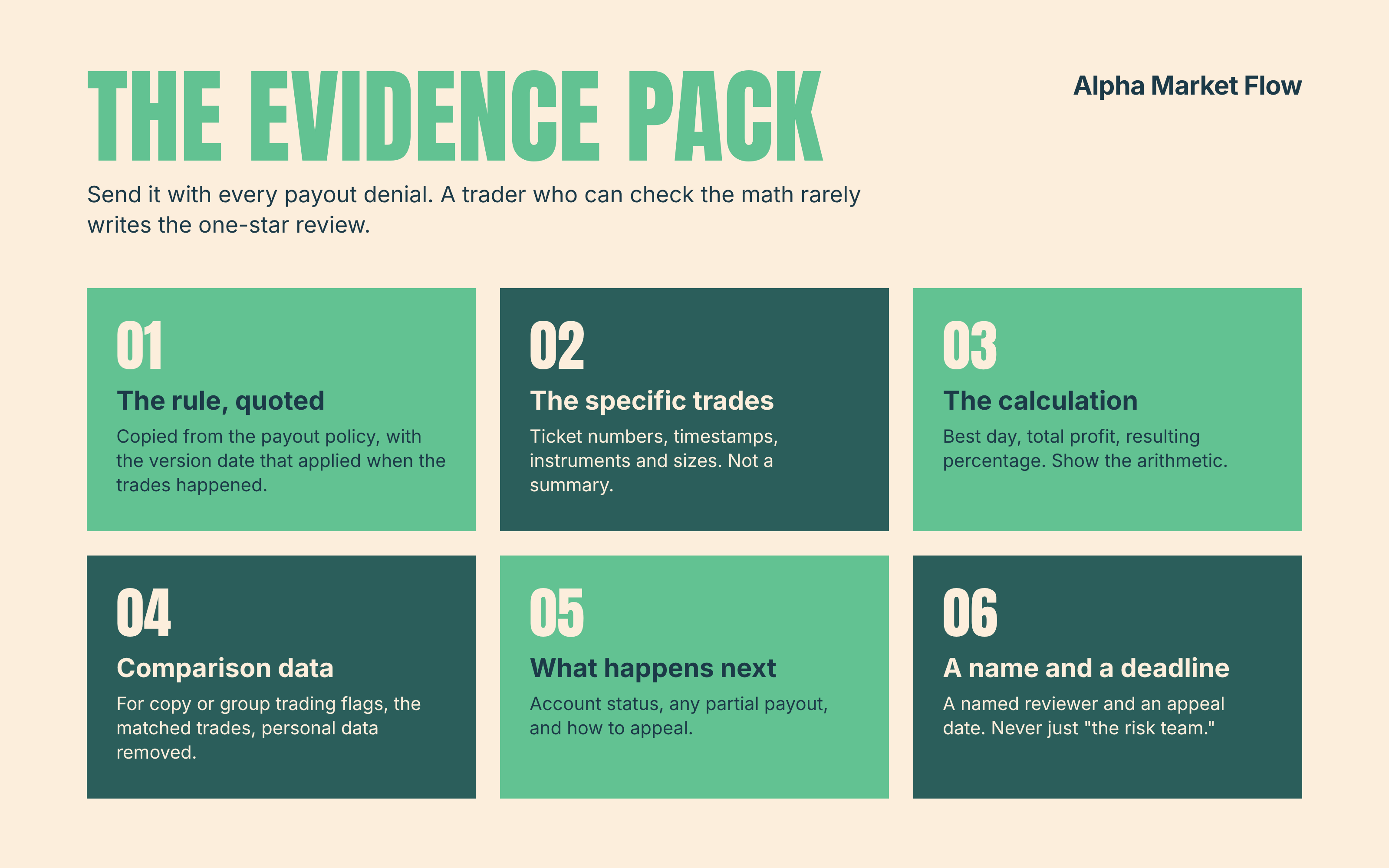
Six-item evidence pack checklist for a prop firm payout denial: the rule quoted with its version date, the specific trades, the calculation, comparison data, what happens next, and a named reviewer with an appeal deadline
The Evidence Pack: Six Items to Send With Every Payout Denial

"You violated our terms" starts a fight. A file showing the exact trades, the exact rule, and the exact threshold usually ends one. Every prop firm payout denial should ship with a standard evidence pack:

  • The rule, quoted, with its version date. Copied from the payout policy page as it stood when the trades happened.
  • The specific trades. Ticket numbers, timestamps, instruments, and sizes, not a summary.
  • The calculation. For a consistency breach, show best day profit, total profit, and the resulting percentage.
  • The comparison data, where relevant. For copy trading flags, the matched trades from the other account, with personal data removed.
  • What happens next. Whether the account stays open, whether profit below the breach is paid, and how to appeal.
  • A named reviewer and an appeal deadline. A person and a date, not "the risk team."

Assume the trader will screenshot it. That is fine. A clear evidence pack posted publicly often helps you more than it hurts, because other traders can check the math. Building this into the support workflow, with macros and a standard file format, is part of how we approach customer support optimization.

Response Templates for the Three Moments That Matter

You will communicate about a denial three times: the private denial notice, the public reply if it reaches a review platform, and the escalation reply if the trader pushes back. Write all three before you need them. Adapt the wording to your own voice, and keep the structure.

The private denial notice

Hi [Name], we've reviewed your payout request for [account ID] dated [date]. We can't approve it because trades [ticket numbers] breach [rule name] in our payout policy (version dated [date], linked here). The attached file shows the trades and the calculation. Here is what happens next: [account status, any partial payout]. If you think we've read your trades wrong, reply by [date] and [reviewer name] will re-check them personally.

The public reply on Trustpilot or a forum

Hi [Name], we're sorry this was frustrating. Your payout was reviewed under [rule name], and we sent you the specific trades and calculation on [date]. We don't share account details publicly, but our payout policy is here: [link]. Our offer to re-check stands, and [reviewer name] can be reached at [support address].

The escalation reply

Hi [Name], thanks for coming back to us. [Reviewer name] re-checked trades [ticket numbers] against [rule name] on [date]. [Either: "We got this wrong, and your payout of $X is being processed today." Or: "The result stands, for the reasons in the attached file."] If you'd like, we can walk through the calculation together on a short call.

Three rules apply to every template. Never argue in public. Never imply the trader cheated. Always point back to a published rule and a named person. The broader reply playbook sits inside our Trustpilot response guidance, and the templates above are the payout-specific layer on top of it.

Track Denials as a Reputation Metric

Most firms track denial rate as a risk number. It is also a marketing number. A rule that triggers far more denials than the others usually has a wording problem, and wording problems reach your support queue before they reach Trustpilot. Track these monthly:

  • Denial rate by rule. Which rule causes the most denials, and is that changing?
  • Appeal overturn rate. If many appeals succeed, the first review is too aggressive.
  • Time to decision. Median days from payout request to answer, against what your policy promises.
  • Denial-linked reviews. How many public reviews mention a denial, and what they say.
  • Support tickets asking "what does this rule mean?" The earliest warning sign you have.

Label the numbers honestly when you publish any of them. "Zero payout denials" is a strong claim; if it is self-reported, say so, and if an outside auditor verified it, name the auditor. Feeding these into one view with the rest of your funnel is where analytics and reporting earns its keep.

When a Denial Goes Public Anyway

Even a perfect process will occasionally produce a viral thread, usually when a trader with an audience disputes a large payout. The worst move is silence. The second worst is a defensive reply that sounds like a press release. Here is the short version:

  • Acknowledge within hours, not days. A short public reply that names the review step buys time.
  • Re-review with fresh eyes. Have someone who did not make the original call check it.
  • Publish the rule, not the trader. Point to the policy page; keep account details private.
  • Reverse fast if you were wrong. A public correction is a trust asset, not a loss.
  • Fix the wording after. If the dispute exposed an unclear rule, update the policy with a dated changelog.

For anything bigger than a single thread, such as a rule change backlash or a wave of reviews, our trust recovery playbook covers the first 72 hours and the 90 days after.

Bringing It All Together

Alpha Market Flow helps prop firm founders treat payout operations as part of their reputation, because that is how traders and AI assistants already treat them. A legitimate prop firm payout denial does not have to become a public crisis.

Publish one plain-language payout policy, define every prohibited strategy as a threshold a trader can check, send an evidence pack with every denial, and have your three reply templates written before you need them. Then track denials by rule so unclear wording gets fixed before it gets reviewed. If you want a second set of eyes on your payout policy and support flow, book a 30-minute call.

Read Next

If payout trust is on your radar, these go deeper on the moments around a denial:

‍

Originally published at alphamarketflow.com. If you're reading this elsewhere, this content has been republished without permission.

Alpha Market Flow Logo
Need some advice before you decide?
We’re here to answer your questions and show you how to get started with growing your fintech firm's reputation and audience.
Schedule a Call
Jana Radojcic
Author Bio

Jana Radojcic

Fintech Organic Growth Strategist

As an SEO manager with more than 5 years of experience, I specialize in building authority that stands the test of time, and all of Google’s latest updates. I turn complexity into clarity for trust-sensitive brands and help them show up where their audience actually searches.

View LinkedIn Profile

Frequently Asked Questions

What is a prop firm payout denial?

A prop firm payout denial is a decision by the firm not to pay all or part of a funded trader's withdrawal request because the trading breached a published rule. Common grounds are consistency rules, prohibited strategies such as copy trading or latency arbitrage, and failed KYC. A denial is defensible when the rule was published before the trades happened and the firm can show the specific trades that breached it.

How should a prop firm communicate a payout denial?

A prop firm payout denial should be communicated privately first, with the exact rule quoted, the specific trades listed, the calculation shown, and a named person the trader can appeal to by a set date. Public replies should point to the published policy without sharing account details. Alpha Market Flow recommends writing these templates before you need them, so no denial goes out as a one-line message.

Why does a prop firm payout denial hurt Trustpilot ratings?

A prop firm payout denial hurts Trustpilot ratings when the trader cannot see why it happened. Reviews tend to focus on vague rule names, long review windows, and silent support rather than on the rule itself. Clear policies and evidence packs remove most of the material those reviews are built from.

What should an evidence pack for a prop firm payout denial include?

An evidence pack for a prop firm payout denial should include the rule as quoted on the date of trading, the ticket numbers and timestamps of the breaching trades, the calculation behind the breach, and the next steps for the account. It should also name a reviewer and give an appeal deadline. Alpha Market Flow builds this into support workflows as a standard file so every denial looks the same.

Can a prop firm payout denial be reversed?

A prop firm payout denial can be reversed when a second review finds the original call was wrong, and firms that reverse quickly and publicly often gain trust rather than lose it. Have someone who did not make the first decision run the re-check. Track how often appeals succeed, because a high overturn rate signals that first reviews are too aggressive or the rule wording is unclear.

Contact

Got a question, idea, or project? Let’s talk.

Leave us a message

Thank you! Your submission has been received!
Oops! Something went wrong while submitting the form.