Previous Article
Next Article
New prop firms do not usually have a review-quality problem first. They have a trust-sequencing problem.
A trader may like the offer, complete a purchase, and still hold back from leaving a public review because the decision to buy happens earlier than the decision to trust. In prop trading, that gap matters more than it does in most categories.
That is why many newer firms underperform on Trustpilot even when the product is decent. Traders want more than a clean landing page or a good-looking challenge. They want signs that the firm is stable, fair, responsive, and likely to honor the experience all the way through payout.
At Alpha Market Flow, we spend a lot of time looking at how trust forms for prop firms and other trust-sensitive fintech brands. One pattern appears again and again: reviews tend to show up after credibility is established, not before.

New findings point to a clear trust gap in prop trading: newer firms are not earning Trustpilot reviews at the same pace as established competitors. Based on an analysis of 235,000+ reviews across 54 firms, the data suggest this is not just a time-in-market issue. It may also reflect broader changes in how review visibility and verification now work.
In a market where trader trust directly affects conversion, low review volume is more than a branding problem. It can make legitimate firms look unproven. While larger firms continue to build review momentum, many newer entrants struggle to gain comparable visibility, raising an important question: are they simply earlier in their growth cycle, or are they entering a reputation system that has fundamentally changed?
At Alpha Market Flow, we specialize in PR and marketing for prop firms, so we looked closely at a pattern we kept seeing: many newer firms were experiencing slow, uneven, and sometimes stalled Trustpilot review growth. This appeared to be more than a customer-volume issue.
Compared with firms that launched only a few years earlier, newer entrants often showed weaker review momentum, suggesting a deeper structural constraint.
That led us to a more focused question: are newer prop firms facing added friction in building visible Trustpilot review volume beyond simply having less time in market? One likely factor is Trustpilot’s evolving verification process, including AI-led flagging and follow-up validation.
Across client accounts, we saw cases where organic reviews were initially published, then removed, with reviewers later asked to provide proof of their interaction before reinstatement.
If a share of users does not complete that extra step, fewer reviews remain live. Over time, that friction can materially reduce visible review count, especially for firms without a large, highly active customer base.
To test that hypothesis, we analyzed 54 prop firms and more than 235,000 Trustpilot reviews, with a primary focus on activity from April 2025 to April 2026. The goal was not just to test the theory, but to better understand what is now shaping review growth in the prop trading market.
The top-line pattern is clear: established prop firms overwhelmingly dominate Trustpilot review volume. Across our dataset, long-standing firms often had review counts in the tens of thousands, while many newer firms remained below a few hundred, and often below 250.
Some of that gap is expected. Older firms have had more time, more customers, and more opportunities to generate feedback. But the scale of the difference is too large to dismiss as a simple maturity gap.
For traders, this is not just a numbers issue. Review volume shapes credibility. A firm with 30,000 reviews looks proven. A firm with 250 can look untested, even when it is legitimate. That creates a real structural disadvantage for newer firms competing for trust.
But total review count only explains part of the story. When we looked at cumulative growth patterns, timing stood out as a major factor. Firms that launched between 2021 and 2023 entered during a period of rapid market expansion, when demand was stronger and review growth was easier to scale.
Firms like FundedNext and FundingPips, both launched in 2022, reached tens of thousands of reviews in a relatively short period, in some cases outpacing firms that had been operating much longer.
The takeaway is important: review growth is not just about time in market. It is also about market timing. That helps explain how the gap formed, but it also raises the more important question for firms launching today: what has changed?
If timing were the only explanation, the story would be straightforward. But the data suggest otherwise. A small group of newer firms, including Top One Futures and Lucid Trading, have surpassed 3,000 reviews within roughly their first year, with growth still accelerating. That shows strong review momentum is still possible, just not evenly distributed.
This points to a more uneven landscape. Existing audiences, stronger distribution, and better review engagement likely help, but platform-level dynamics may also be affecting firms differently.
Some newer firms continue to scale review volume quickly. Others show a very different pattern: early momentum, followed by a sharp slowdown or near-complete stall.
That stalled trajectory is one of the clearest signals in the analysis. If a firm is still active and acquiring users, review activity should not disappear so abruptly. One plausible explanation is added friction in the review publication process. If users must complete extra verification after submitting a review, some will drop off before their feedback is reinstated. Over time, that can materially suppress visible review growth.
Not every case can be explained by platform dynamics alone. Execution, retention, and customer engagement still matter. But the consistency of this pattern across multiple firms suggests structural friction may be playing a meaningful role.
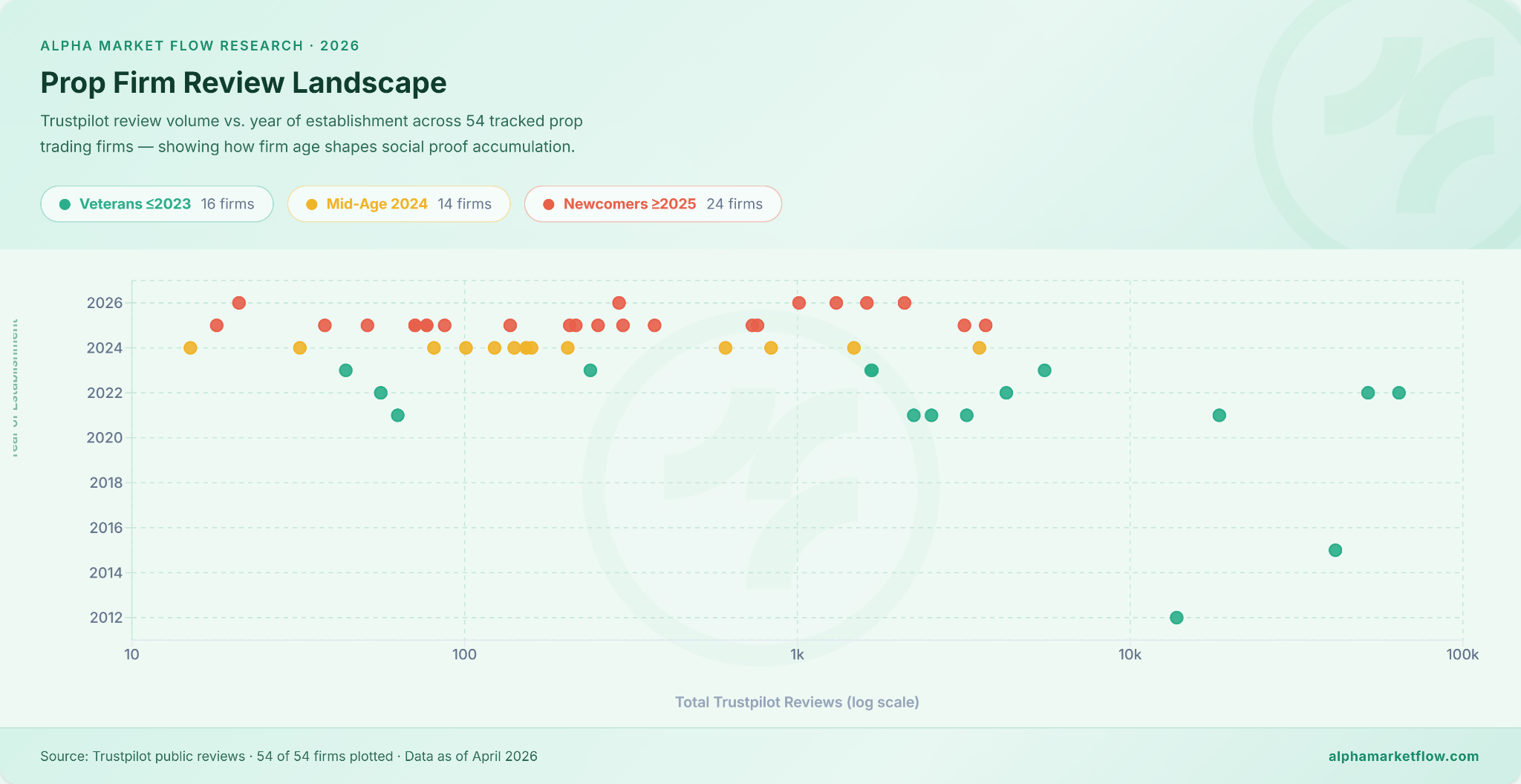
One of the clearest patterns we found is how widely newer firms differ from each other. A small number can generate thousands of reviews in their first year, while most stay below 50. In our view, that gap is too large to be explained by time in market alone. Review growth appears to depend on a mix of factors, including acquisition strategy, brand positioning, and how effectively firms engage their users.
What this tells us is that structural friction may be real, but it does not affect every firm the same way. Some newer firms are clearly able to break through, while most struggle to do the same.
We also found that review volume and review quality are not the same thing. High ratings appear across both newer and more established firms. Some newer firms maintain exceptionally strong scores, while some larger firms show more mixed feedback.
That suggests visibility may be influenced by external factors, but review quality is still shaped by the actual user experience.
For us, that is an important distinction. A firm can have low visibility and still deliver a strong product. Another can dominate in review count without delivering the same level of satisfaction.
In other words, credibility is not built on volume alone. It comes from the combination of visibility, consistency, and user experience.
So, are newer prop firms at a disadvantage? Based on what we found, I’d say yes, but not in a simple or absolute sense. Established firms still benefit from scale, brand history, and momentum built during earlier growth cycles. At the same time, we believe newer firms are entering a more complex environment, where added post-review verification may be slowing visible review growth.
That said, this is not a closed system. We still see some newer firms scaling quickly, while others stall.
Our conclusion is that firms launching today may face real structural friction in building Trustpilot review volume, especially as verification systems evolve, unless they already have strong demand, distribution, or user engagement working in their favor.
For us, this goes beyond prop firms. It reflects a broader shift in how trust is built on digital platforms.
As review systems become more automated and more restrictive, understanding these dynamics will matter more for any company operating in a competitive, trust-driven market.
Our proposed solution is straightforward: move verification earlier in the process. If proof of experience is required upfront, at the point of review submission, platforms can validate legitimacy before publication rather than removing reviews afterward and asking users to follow up.
Based on what we’ve seen, that post-submission step creates avoidable drop-off. Even legitimate reviewers often do not complete the extra verification, which means valid reviews never make it back online.
Many founders assume the answer is to ask for reviews more often. Sometimes that helps. Most of the time, it is only a partial fix.
The bigger issue is that public reviews sit downstream from several trust events:
Until those moments happen, a lot of satisfied users stay quiet.
That creates a common misread. A firm can look weaker on Trustpilot than its actual customer experience would suggest simply because it has not built enough public proof yet.
Established firms usually have more evaluation attempts, more funded accounts, more payouts, and more support interactions resolving successfully at scale.
New firms have fewer total customer journeys, which means fewer moments that naturally trigger a review. Even if sentiment is positive, volume grows slowly when there are not many milestone events to begin with.
Prop traders do not just ask whether an offer is attractive. They ask whether the firm feels safe to trust.
That usually means they wait for signs such as:
In other words, the review often comes after the trader decides the firm passed a credibility test.
Most satisfied customers do not write reviews automatically. They move on.
Without a clear review process, good experiences stay private while frustration becomes public faster. That is one reason early review profiles can look more negative or more volatile than the underlying customer base actually is.
At low review counts, every visible issue carries more weight.
A delayed response, a confusing rule, or a poorly explained payout timeline can shape perception far more than it would for a larger firm with a long public history. Smaller review profiles are fragile. One or two poor experiences can distort trust for months.
When newer prop firms start growing reviews consistently, it is usually because they improved credibility systems, not because they found a clever way to ask louder.
The firms that improve review velocity tend to do five things well:
Trust improves when traders can quickly understand the rules, payout structure, resets, restrictions, and progression path.
Confusion creates hesitation. Clarity creates confidence.
The strongest proof assets are the ones that help traders verify, not just admire.
That can include payout evidence, transparent explanations of rules, visible support standards, and content that answers objections before they turn into complaints.
Timing matters more than frequency.
The best review requests usually happen after a meaningful point in the journey: a smooth onboarding experience, a resolved support case, a funded milestone, or a successful payout event.
For new firms, public responses matter almost as much as the reviews themselves.
A calm, useful response shows future buyers that the brand is present, accountable, and not hiding from friction.
Trustpilot performance is rarely just a marketing output. It reflects product design, support operations, communication quality, and how predictable the customer journey feels.
That is why reputation work compounds when it is tied to the business, not handled like a one-off campaign.
Most firms do not need a more aggressive review strategy first. They need a more credible customer journey.
In prop trading, reviews are usually an output of trust, not a substitute for it.
That is why newer firms often struggle to build review count even when they are doing some things right. Trust forms later than interest. Public proof accumulates later than purchases. And until that gap is closed, review growth will lag behind what founders expect.
The firms that solve this fastest are not always the ones with the flashiest promotions. They are the ones that remove uncertainty better than everyone else.
If you want more Trustpilot reviews, the answer is rarely just “ask more.”
A better question is: what has the trader seen, experienced, or verified that makes leaving a public review feel safe?
Once that answer is strong, review growth tends to follow.
Alpha Market Flow works with prop firms and other trust-sensitive fintech brands on reputation, content, SEO, customer support optimization, and growth systems.
Part 2 of our Research: Trustpilot Invited Reviews: What 14,277 Prop Firm Reviews Show
Want to see where your brand stands before you scale? Start with the Reputation Readiness Assessment.
Originally published at alphamarketflow.com. If you're reading this elsewhere, this content has been republished without permission.