Trustpilot Invited Reviews: What 14,277 Prop Firm Reviews Show

In March 2026, Italy's competition authority fined Trustpilot 4 million euros after finding that the platform's review collection services allow businesses to select which consumers receive review invitations, the exact mechanism that produces Trustpilot invited reviews (Source: AGCM).

Alpha Market Flow builds reputation systems for prop firms, and questions about how review scores are actually constructed come up in nearly every audit we run. So we went and measured it.

We analyzed 14,277 Trustpilot reviews collected from 52 active proprietary trading firms over a rolling twelve-month period, separating reviews that began with a business invitation from reviews customers wrote on their own.

This article gives you the full methodology, the three findings that emerged, and what they mean whether you are comparing firms or running one.

Previous Article
Next Article

Chapters

Key Takeaways

  • Invited reviews made up 48.0% of the 14,277 reviews analyzed.
  • Invited reviews averaged 1.03 more stars than customer-initiated reviews.
  • One-star reviews: 29.6% of organic reviews, 5.6% of invited reviews.
  • Alpha Market Flow research shows Trustpilot invited reviews follow different rating patterns.
  • Collection method shapes a TrustScore as much as service quality does.

What Trustpilot Invited Reviews Actually Are

A Trustpilot review reaches the platform through one of two doors, and the door it came through is recorded. Understanding that distinction is the foundation of everything below.

  • Invited reviews begin with the business. The firm sends a review request, usually through Trustpilot's API or an automated integration triggered by a customer event.
  • Organic reviews, which Trustpilot also calls customer-initiated, begin with the customer. Someone decides on their own to find the firm's profile and write something.
  • Both types are legitimate under Trustpilot's guidelines, and both feed the same public TrustScore.
  • Both are visible to anyone who checks, because Trustpilot labels the origin of each review.
  • Customers who receive an invitation remain free to write whatever they want, including a one-star review.

The critical point is not that invitations exist. It is that the business controls when the invitation goes out. That timing decision is the variable this analysis set out to measure, and it is the same variable the Italian regulator focused on.

For context on why any of this moves revenue, our breakdown of prop firm reputation management covers how review signals feed conversion.

How We Ran the Analysis

Research is only useful if someone else can interrogate the method. Here is exactly what we did and what we did not do.

  • Sample: 14,277 Trustpilot reviews scraped from 52 active proprietary trading firms.
  • Classification set: 6,857 of those reviews carried a Trustpilot origin tag and could be classified. All origin comparisons below run on that subset.
  • Window: a rolling twelve-month period.
  • Classification: each review was labeled business-invited or customer-initiated using Trustpilot's own review origin labels, not our judgment.
  • Comparisons: share of reviews by origin, average star rating by origin, and distribution of one-star ratings by origin.
  • Scope limits: we did not assess whether any individual review was genuine, and we did not evaluate any named firm.

Three questions drove the work. How many reviews came from invitations versus customers acting alone? Did the two groups receive different average ratings? And were the lowest ratings distributed differently between them?

We took no position on whether invited reviews should count, because Trustpilot has already answered that and the answer is yes. Our analytics and reporting practice applies the same principle to client data: state the method, then let the numbers carry the argument.

What the Data Shows

Three findings emerged, and they compound on each other.

Bar chart comparing star rating distribution of organic and invited Trustpilot reviews across 52 prop firms
Organic and invited reviews split one public rating into two very different distributions.
  • Volume: 3,127 of the 6,857 classified reviews were business-invited, or 45.6%. Close to half of the traceable public feedback on these firms started with the firm.
  • Average rating: invited reviews averaged 1.03 stars higher than organic reviews. On a five-point scale, a full star is not a rounding artifact. It is the difference between a 3.9 and a 4.9.
  • Low-rating distribution: 29.6% of organic reviews were one star, against 5.6% of invited reviews, a 5.3 times difference. Widening to one and two star ratings, 31.4% of organic reviews were negative versus 6.9% of invited ones.
  • Top-rating distribution: 60.5% of organic reviews were five star, against 85.7% of invited reviews.

The gap held consistently across the dataset rather than being driven by a handful of outlier firms. Read together, the three findings describe a single effect: when about half of a firm's reviews arrive through a channel that skews a full star higher and carries a fraction of the one-star ratings, the blended public score sits meaningfully above what the organic channel alone would produce.

That is a measurable property of how the score was assembled. Firms serious about understanding their own numbers should start with an honest reputation and PR audit.

Book a call with Alpha Market Flow if you want your firm's review mix analyzed against this dataset.

Why the Gap Appears

A one-star average difference invites the assumption that something improper is happening. The data does not support that reading, and a more ordinary explanation fits better.

  • Selection by timing: automated invitations commonly fire on positive events, such as a completed payout, a passed evaluation, or a resolved support ticket.
  • Selection by state: a trader who just breached a rule and lost an account is rarely in the invitation queue at that moment.
  • Effort asymmetry: writing an unprompted review takes real motivation, and frustration supplies more of it than satisfaction does.
  • Channel difference: an invitation removes friction for a customer who would not otherwise have bothered, which surfaces quieter and generally more positive experiences.

None of these mechanisms requires bad faith. A firm can configure invitations at payout confirmation for entirely sensible operational reasons and still produce this pattern. What matters is that the pattern is real and structural, not that anyone intended it.

The Italian regulator described the same underlying concern in different language, finding that letting businesses choose invitation recipients carries implications for how representative the published ratings are.

Trustpilot has said it disagrees with that finding and is appealing it. Our PR Intelligence Framework exists because signals like this need interpretation rather than a single headline number.

What This Means for Anyone Comparing Prop Firms

A TrustScore remains a useful signal. It is just a signal that rewards a second look.
  • Check the invited versus organic split on the profile before reading the headline number.
  • Read the organic reviews as a separate body of evidence, since they represent the unprompted experience.
  • Treat a firm with heavy invitation volume and very few organic reviews as incomplete information, not as a red flag.
  • Compare the two channels within the same firm rather than comparing headline scores across firms with different collection habits.
  • Weight recency, because a firm's invitation configuration can change without notice.
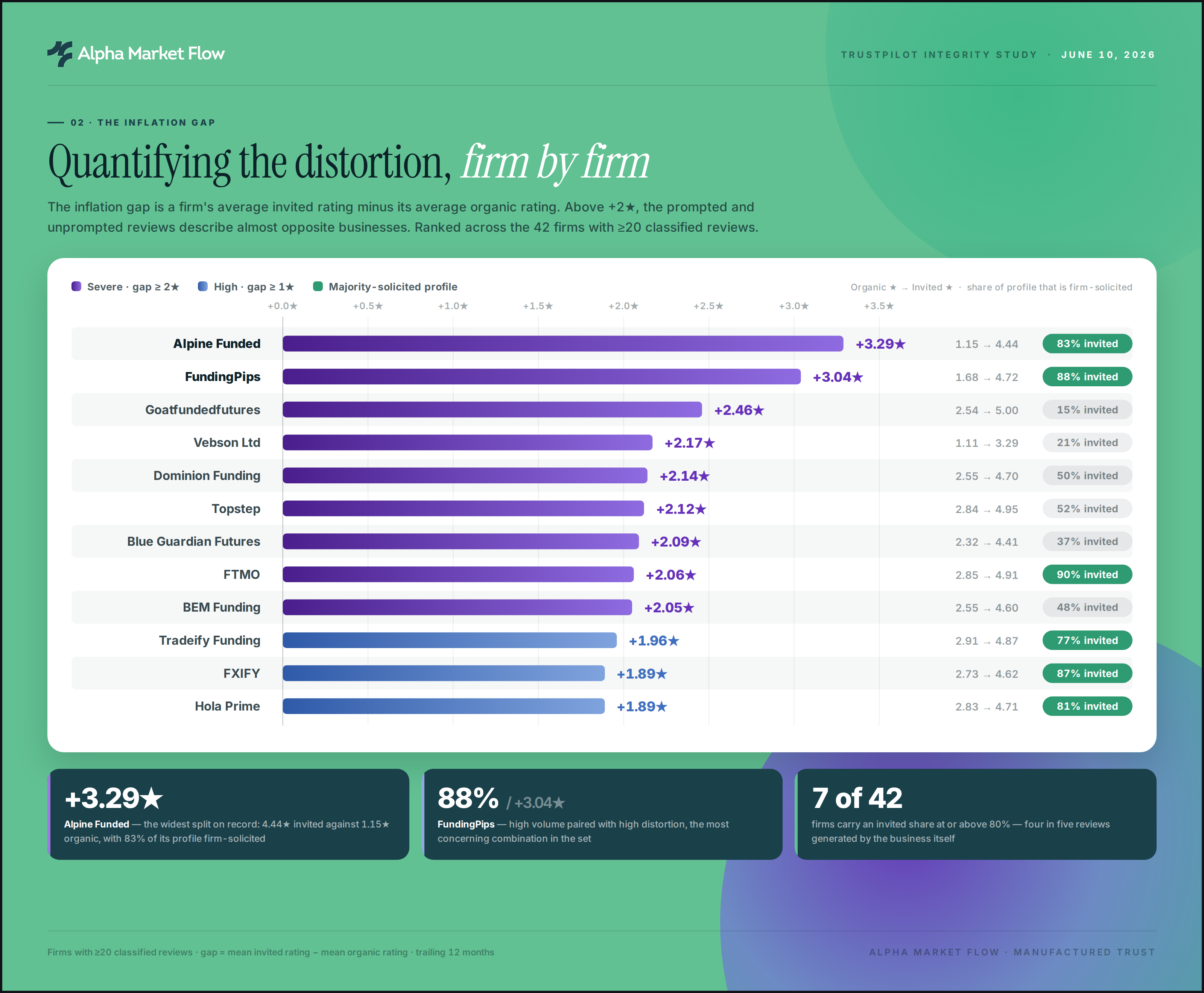
Ranked chart of the 12 prop firms with the widest gap between invited and organic Trustpilot ratings
The inflation gap is a firm's average invited rating minus its average organic rating.

Two firms can post identical TrustScores while having built them from completely different review mixes. That does not make either score dishonest. It means the number alone does not tell you what you need to know, which is a point we develop further in our guide to prop firm comparison criteria.

What This Means If You Run a Prop Firm

For founders, the finding cuts in two directions at once, and both are worth sitting with.

Scatter plot of prop firms by invited review share against rating inflation gap
Invited share on the horizontal axis, rating lift on the vertical. Find where your firm sits.
  • Your score is partly a product of your invitation configuration, so you should know what that configuration is before defending the number.
  • A high blended score built on thin organic volume is fragile, because a bad news cycle brings organic reviewers out in force.
  • Organic one-star reviews are your cheapest source of product intelligence, since they cost a frustrated customer real effort to write.
  • Suppressing negative signal does not remove the underlying problem, it just delays your awareness of it.
  • Traders and AI assistants are both getting better at reading review composition rather than review averages.

That last point is the one most founders underestimate. Language models summarizing your firm increasingly parse review patterns rather than repeating a score, which we cover in getting recommended by ChatGPT. A score you cannot explain is a liability the moment someone asks how you built it.

Collecting Reviews Without Distorting the Picture

You do not have to choose between inviting reviews and having a representative profile. You have to invite deliberately.

  • Broaden the trigger. Invite across the full customer lifecycle, not only at payout or at a passed evaluation.
  • Include the hard moments. Invite after a resolved dispute or a declined payout, once the resolution is complete.
  • Keep timing consistent. A fixed rule applied to all customers is defensible in a way that discretionary sending is not.
  • Track your own split. If your invited share climbs past three quarters, your profile is drifting away from the organic experience.
  • Respond to organic negatives publicly. A substantive reply does more for a prospect's confidence than an extra five-star review.
  • Fix root causes. Recurring one-star themes usually point at a rule, a payout timeline, or a support gap, not at the reviewer.

Firms that invite broadly end up with lower headline scores and far more durable ones, because the number survives scrutiny. The operational side of this work, particularly response times and dispute handling, sits with customer support optimization, since most one-star reviews start as an unanswered ticket.

The Full Ranking

Below is every firm in the study that cleared 20 classified reviews, 42 of the 52 active firms tracked. It is published in full so the finding can be checked rather than taken on trust.
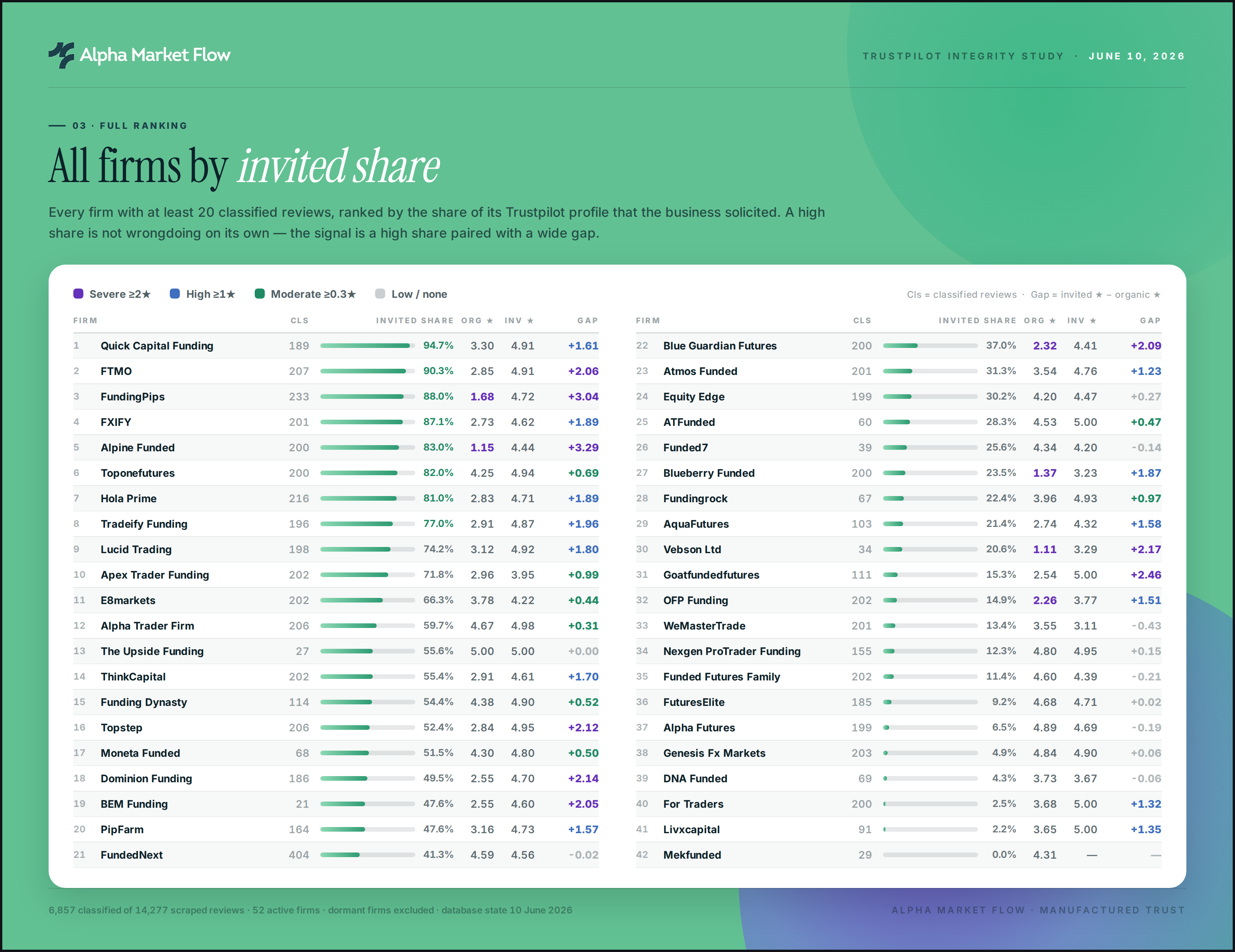
Table of 42 prop firms ranked by invited share of Trustpilot profile with organic and invited averages
Every firm with at least 20 classified reviews, ranked by the share of its profile that the business solicited.

Read it in two columns rather than one. Invited share on its own says very little, since a firm can solicit heavily and still post a narrow gap when the underlying service is consistent.

The gap column on its own says little either, because a wide gap on a thin invited sample is noise. The combination is the signal, and it is the same combination we look for in a prop firm SEO audit when trust metrics stop matching the traffic.

Conclusion

Alpha Market Flow published this analysis because prop firm founders deserve better than a number they cannot interrogate. Across 6,857 classified reviews from 52 firms, invited reviews accounted for 45.6% of the set, averaged a full star higher than organic reviews, and carried roughly a fifth of the one-star rate.

None of that makes invited reviews invalid, and none of it implies misconduct by any firm. It means a TrustScore is an assembled artifact, and knowing how it was assembled changes how you read it.

If you want to know what your own review composition says about your firm before a trader or a language model works it out first, schedule a call with our team.

Read Next

More on how trust signals shape prop firm growth:

Originally published at alphamarketflow.com. If you're reading this elsewhere, this content has been republished without permission.


Alpha Market Flow Logo
Need some advice before you decide?
We’re here to answer your questions and show you how to get started with growing your fintech firm's reputation and audience.
Schedule a Call
Jana Radojcic
Author Bio

Jana Radojcic

Fintech Organic Growth Strategist

As an SEO manager with more than 5 years of experience, I specialize in building authority that stands the test of time, and all of Google’s latest updates. I turn complexity into clarity for trust-sensitive brands and help them show up where their audience actually searches.

View LinkedIn Profile

Frequently Asked Questions

What are Trustpilot invited reviews?

Trustpilot invited reviews are reviews that begin with a business sending a review request to a customer, rather than a customer independently deciding to write one. They are a standard feature of Trustpilot's platform and count toward the same public TrustScore as customer-initiated reviews. Trustpilot labels each review's origin, so the split is visible on any profile.

Are Trustpilot invited reviews legitimate?

Trustpilot invited reviews are legitimate and permitted under Trustpilot's own guidelines. Customers who receive an invitation remain free to leave any rating, including a one-star review. The question this analysis raises is not legitimacy but representativeness, since the business controls when invitations are sent.

Do Trustpilot invited reviews get higher ratings than organic reviews?

Trustpilot invited reviews did receive higher ratings in Alpha Market Flow's analysis of 14,277 reviews across 52 prop firms. Invited reviews averaged 1.03 stars more than customer-initiated reviews, and one-star ratings appeared in 5.6% of invited reviews compared with 29.6% of organic ones. The gap held consistently across the dataset.

How can I tell how many Trustpilot invited reviews a prop firm has?

You can tell how many Trustpilot invited reviews a firm has by checking the origin label Trustpilot attaches to each review on the company profile. Filtering by that label shows the split between invited and organic feedback. Reading the organic subset separately gives you a clearer view of the unprompted customer experience.

Should my prop firm stop sending Trustpilot invited reviews?

Your prop firm should not stop sending Trustpilot invited reviews, but it should widen when they go out. Inviting across the full customer lifecycle, including after resolved disputes, produces a lower headline score that holds up far better under scrutiny. Alpha Market Flow helps prop firms design review programs that stay representative, which matters more each year as traders and AI assistants read review composition rather than averages.

Contact

Got a question, idea, or project? Let’s talk.

Leave us a message

Thank you! Your submission has been received!
Oops! Something went wrong while submitting the form.