Previous Article
Next Article
Any prop firm reputation report published in 2026 has to start from a hard fact: on 30 September 2026, 47 of the 232 prop firm Trustpilot profiles re-checked in one industry tracker, or 20.3%, showed a guidelines-breach notice in place of a star rating (Source: PropFirmMap).
Alpha Market Flow built the PR Intelligence Score to measure exactly this kind of exposure, and this report applies it to the twenty firms traders are most likely to find first.
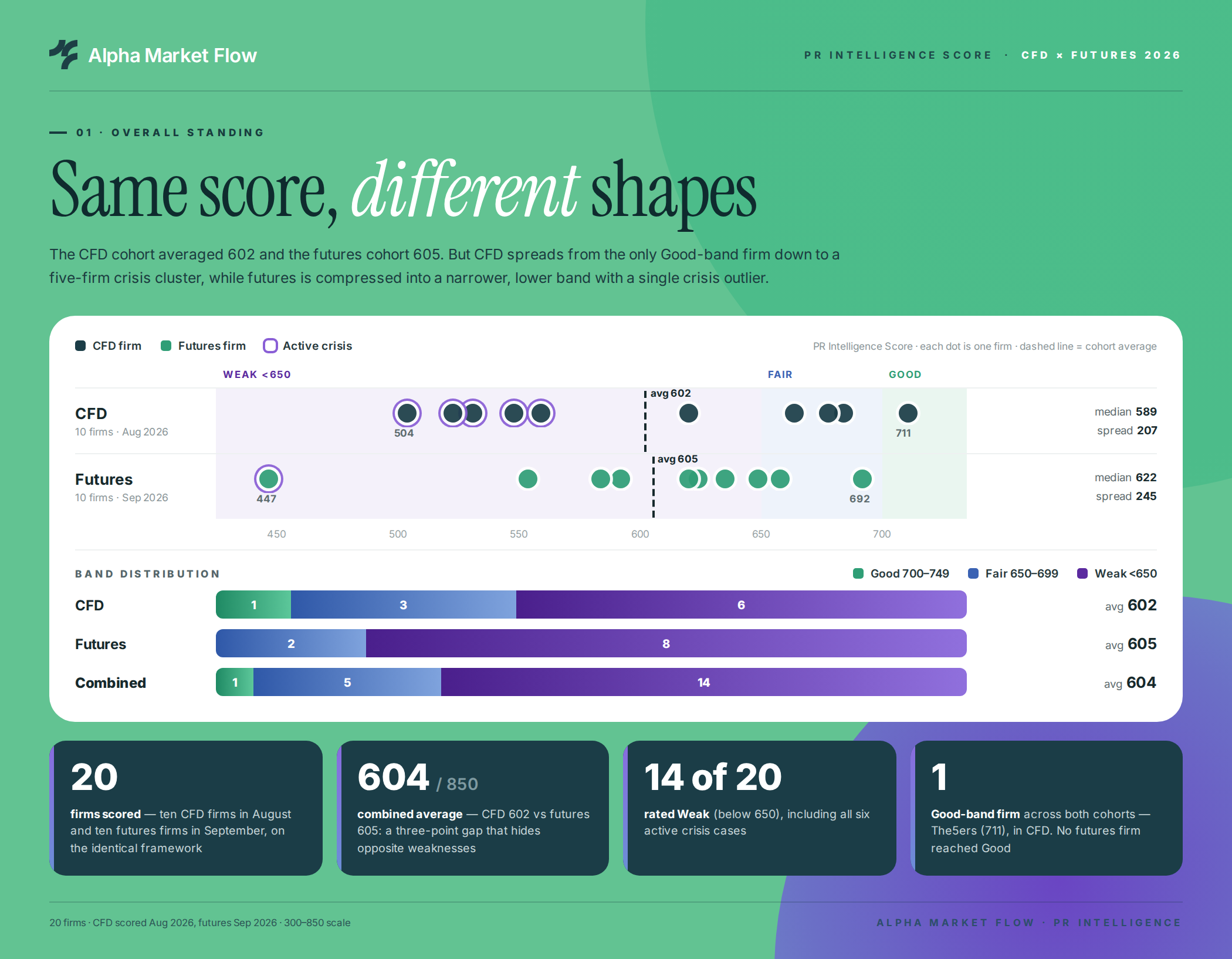
We scored ten leading CFD prop firms in August 2026 and ten leading US futures prop firms in September 2026, using the identical framework, weights, and definitions for both cohorts. Presented together, the two cohorts show something neither showed alone: the segments land on almost the same average score, but they are weak in opposite places.
This article gives you the full methodology, every score, the category-by-category comparison, the limits of the data, and what the findings mean if you run a CFD or futures prop firm.
This report consolidates two consecutive PR Intelligence Score cohorts into a single cross-segment analysis of twenty firms. At the top line, the two segments are nearly level, which is exactly why the detail underneath matters.
The CFD segment was dragged down by a five-firm Trustpilot crisis cluster, yet it is comparatively mature on content and growth, and it produced the only firm in either cohort to reach the Good band. The futures segment is almost free of systemic crisis, with one isolated case, but its firms consistently underperform on the visible, effort-driven signals: half never respond to a public review, earned media is absent at most of them, content is thin, and no firm grew its review base.
Brand Trust and Sentiment is the strongest category in both segments. That confirms a finding running through all of our PR Intelligence Framework work: underlying sentiment is rarely the problem, and converting it into visible, defensible reputation is.
A trader evaluating any prop firm begins the same way regardless of product. They search the firm's name, and the first page of results shapes whether they continue.
In a largely unregulated market, that first results page functions as a primary trust surface and a major input into a trader's decision. It is also increasingly what language models read before they answer, which is why we treat this work as part of what AI tells traders about your firm.
The PR Intelligence Score measures that surface on a fixed, decomposable 300-850 scale, so scores are directly comparable across firms, across time, and, as this report shows, across product segments. Scoring both segments on the identical framework makes them comparable for the first time, and the segment differences, shared weaknesses, and cross-segment brand signal are only visible when the two cohorts sit side by side.
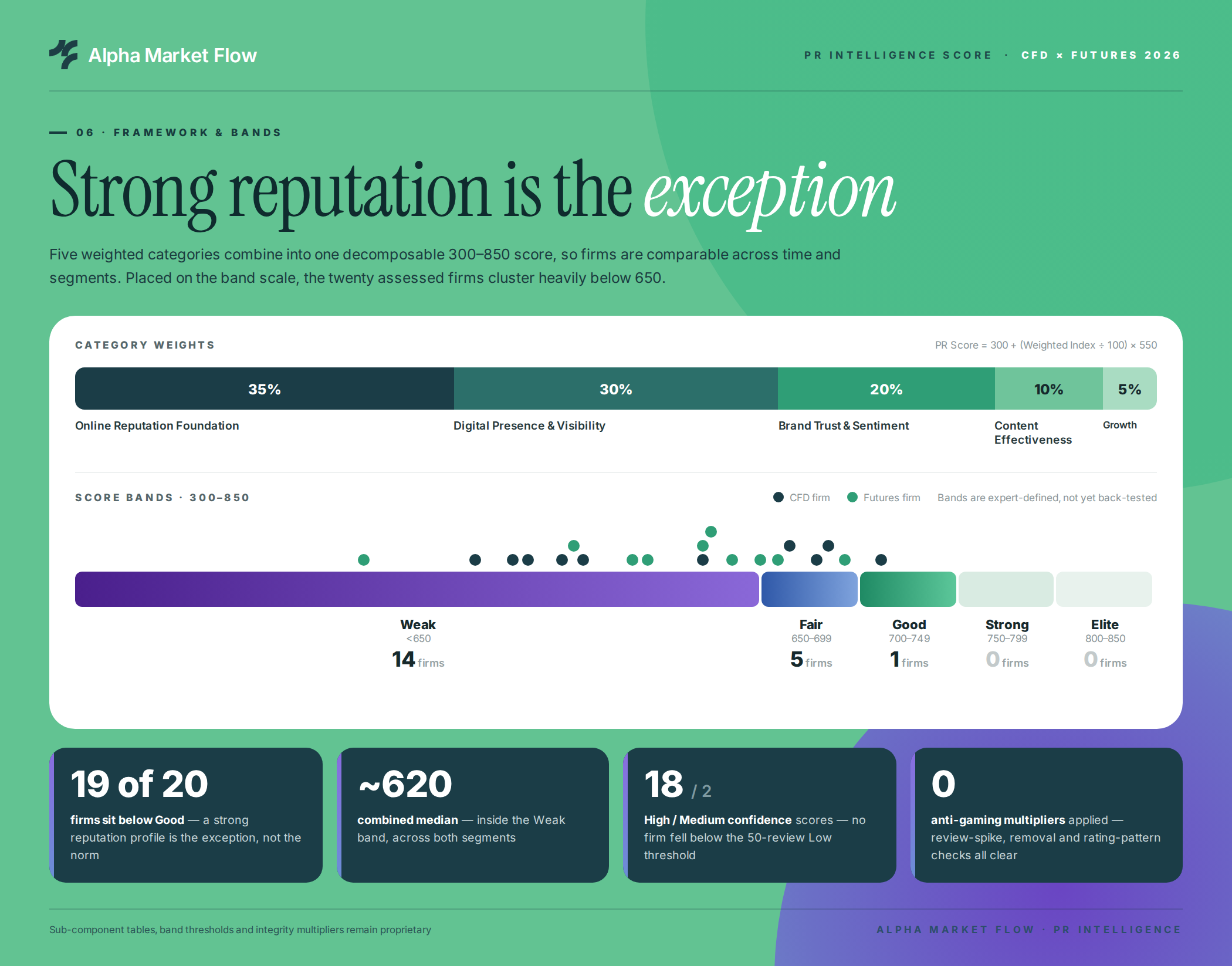
The PR Intelligence Score measures public brand health across five weighted categories. The weights reflect how much each signal type influences a prospective trader's trust-formation process, and both cohorts were scored with the same weights and definitions.
Each category is scored 0-100 from its sub-components, and the five combine into a weighted index that maps linearly onto the output scale:
Growth Momentum compares a firm's most recent 30-day window of new reviews against the prior 30-day window. It captures momentum, not the star rating or cumulative review count.
It carries the lightest weight because it is a leading, directional signal rather than a measure of reputation a firm already holds. The same principle of stating the method before the result runs through our analytics and reporting practice.
Every firm was scored on the identical framework and ranked within its segment. Only one firm clears 700, and six carry an active crisis.
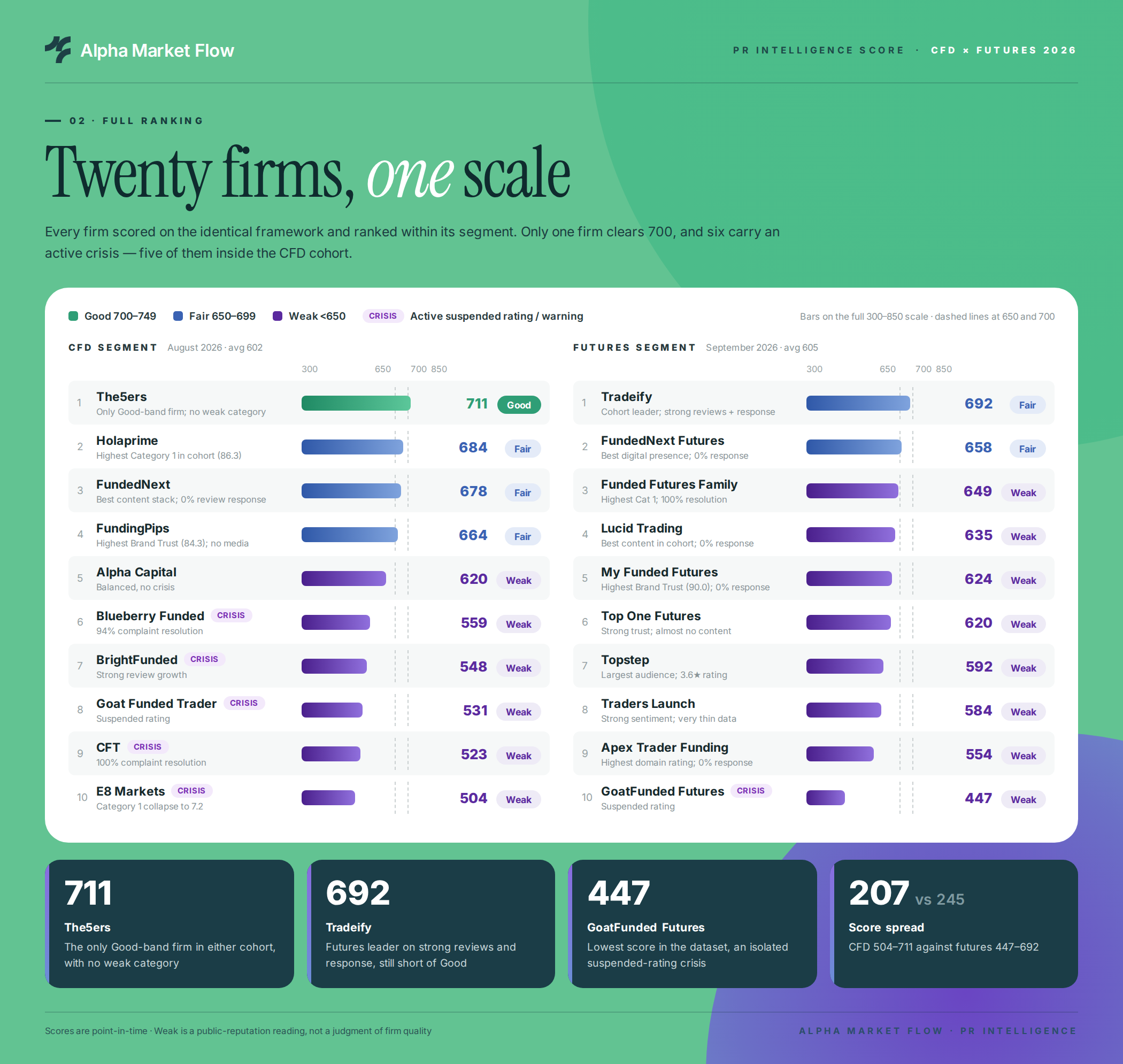
Ten CFD prop firms, average 602, median 589, spread of 207 points (504 to 711). The distribution was one Good, three Fair, and six Weak.
The defining feature was a five-firm Trustpilot crisis cluster: five firms carrying active Consumer Warnings and suspended ratings tied to a wave of mass account-breach complaints. That cluster dragged the segment's Online Reputation Foundation average down to 49.8. Above it, the segment produced the only firm in either cohort to clear 700.
Ten US futures prop firms, average 605, median 622, spread of 245 points (447 to 692). The distribution was zero Good, two Fair, and eight Weak.
The crisis here is isolated to a single firm. The segment's weakness is operational: Digital Presence (45.2) and Content (40.3) are starved, five of ten firms never respond to public reviews, including the two largest by volume, and no firm grew its review base. The cohort tops out in Fair at 692. For new entrants, that ceiling is also an opening, which we cover in futures prop firm marketing.
Decomposed into its five categories, the comparison stops looking like a tie. The two segments trade strengths almost cleanly.
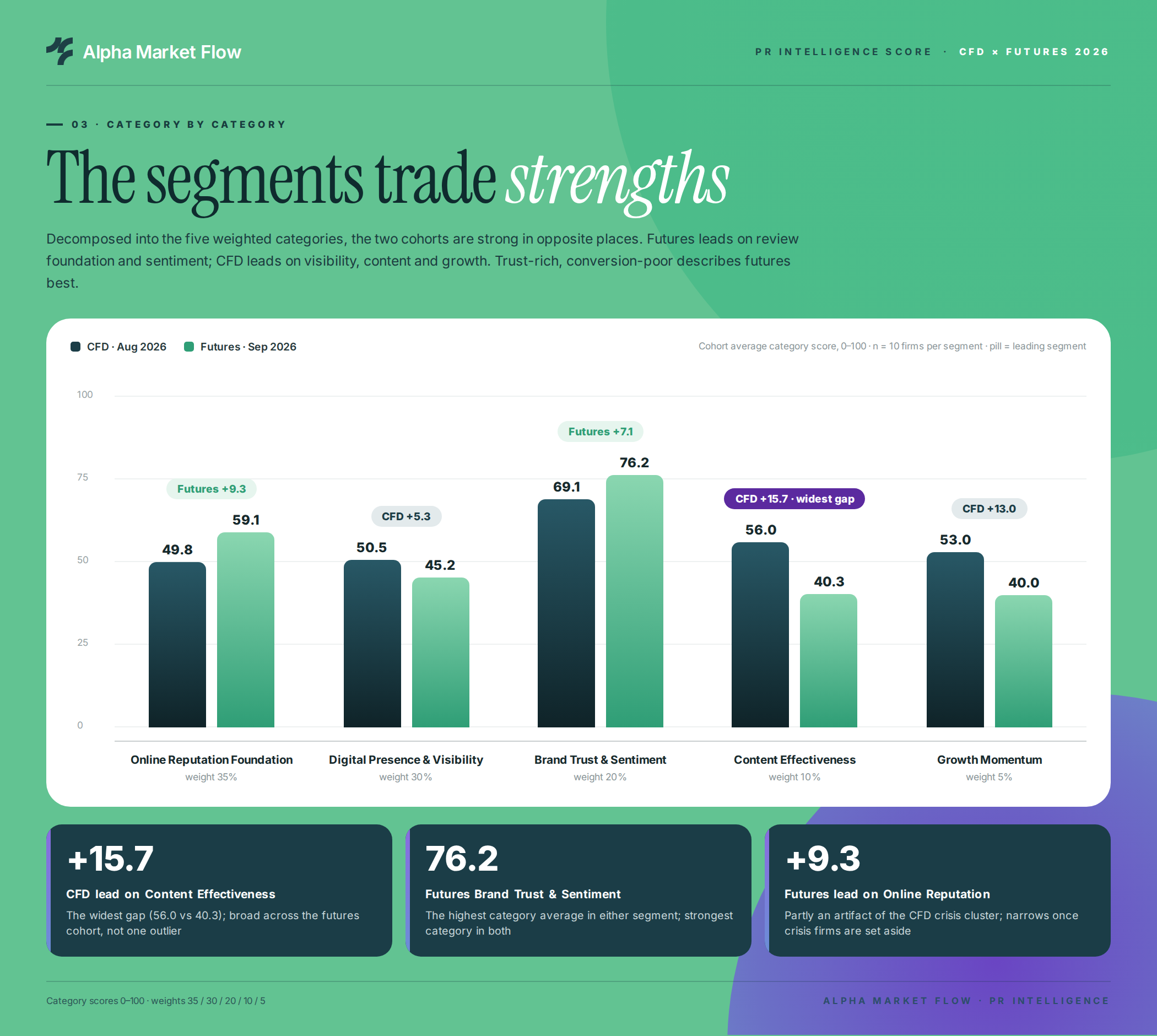
Read the table with three caveats in mind.
The best description of the futures cohort is trust-rich but conversion-poor: strong underlying sentiment that the segment has not yet turned into visible, balanced reputation infrastructure. CFD firms, by contrast, carry genuine educational stacks and several grew their review base, which is the kind of signal our invited review research shows traders now read closely.
A three-point gap inside a twenty-firm dataset is not a meaningful difference. The better lens is dispersion.
These figures describe the two assessed ten-firm cohorts and should not be read as estimates for the full CFD or futures markets.
The single sharpest difference between the segments is the shape of the crisis. The mechanism behaved identically in both, but its incidence could hardly be more different.
CFD risk in this cohort is concentrated and event-driven. If you want to see how fast that kind of event moves once it starts, our crisis management case study walks through one in real time.
Futures weakness, by contrast, is distributed across routine reputation operations rather than concentrated in a single failure.
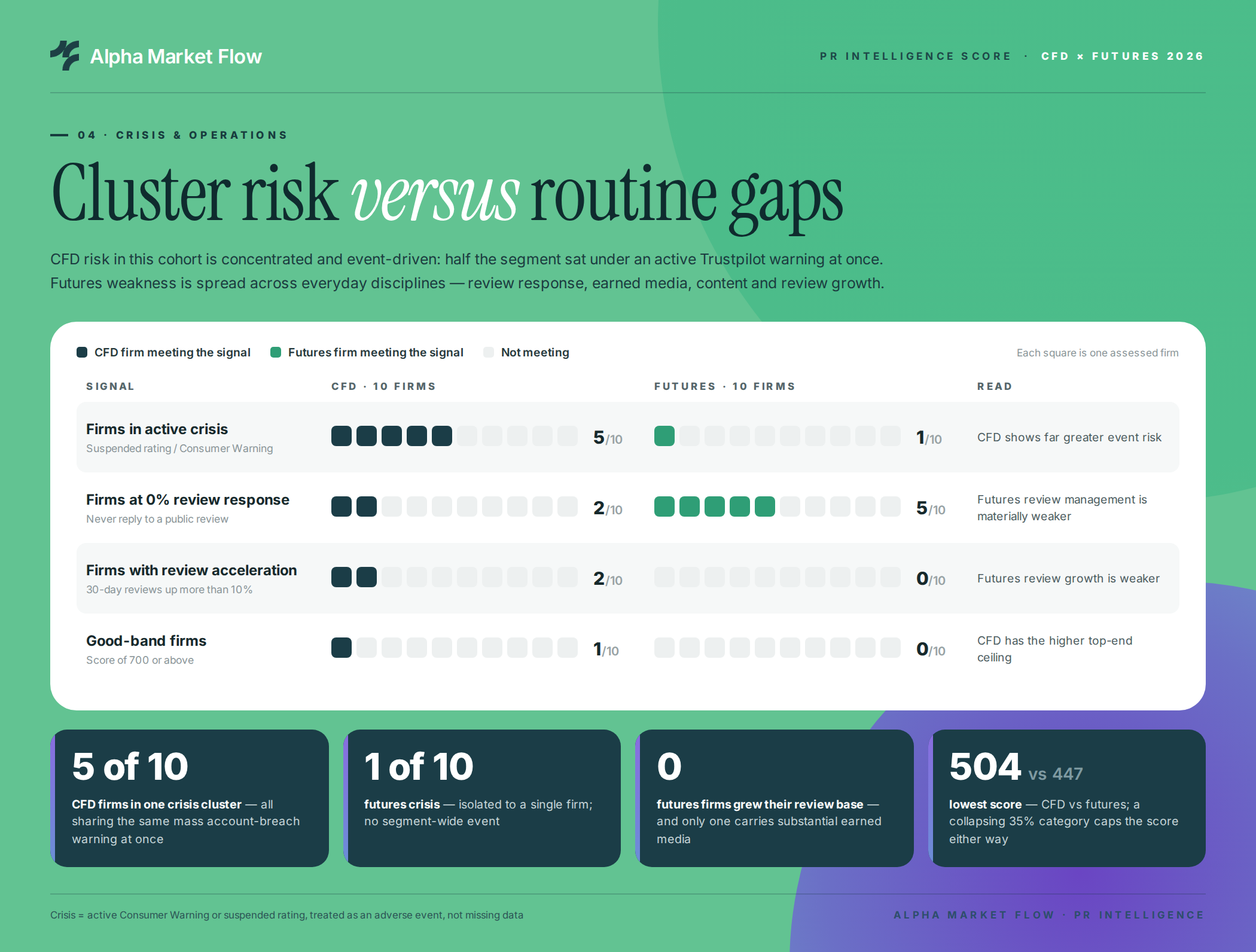
Response neglect matters more than it looks, because 97% of consumers who read reviews also read the business's replies to them (Source: BrightLocal). None of these gaps requires a crisis to fix or an outside budget to address. They are routine disciplines that sit inside reputation and PR management, and most of them start as an unanswered support ticket.
Want to know which of these gaps your own firm carries? Alpha Market Flow can map your score before a trader or a language model does, so get in touch with us.
Two brands appear in both cohorts, scored roughly two months apart on different product lines. Both showed strongly consistent reputation patterns across products, which is a genuinely interesting signal that should be read as directional rather than conclusive.
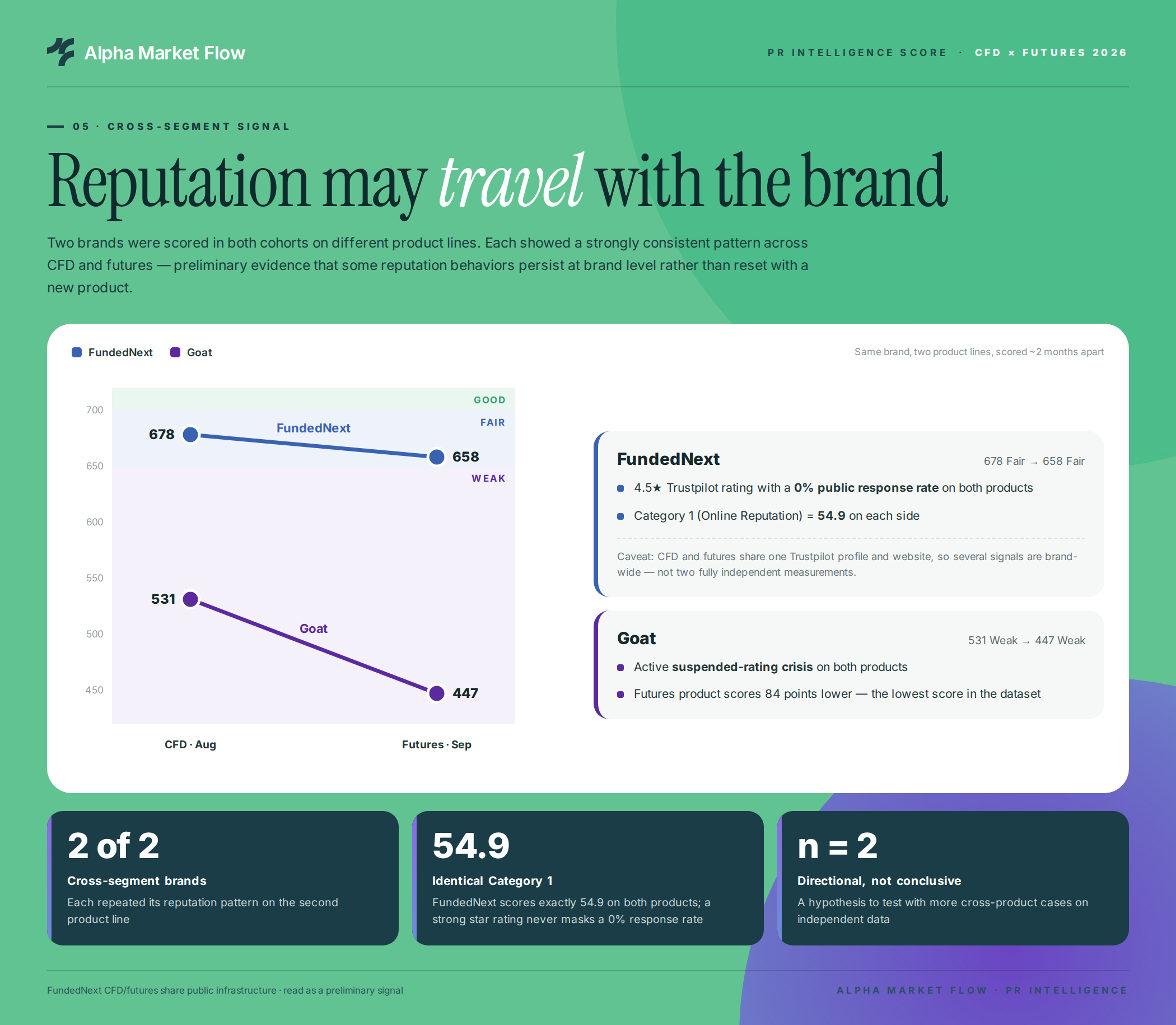
Taken together, the two cases offer preliminary evidence that some reputation behaviours persist at the brand level rather than resetting with a new product.
The right reading is a hypothesis to test with more cross-product cases on independent data. For operators planning a second product line, it is a reason to treat prop firm reputation management as a brand-level asset, not a per-product task.
Across twenty firms and two segments, the framework shows three properties that separate a multi-factor intelligence model from a single-metric ranking table, plus one preliminary signal worth further testing.
That first property is the practical one for founders. A score that tells you where you are failing is a work plan; a single star average is only a mood.
Our earlier PR Intelligence audit coverage is collected in the Alpha Market Flow newsroom if you want to see how the framework has evolved.
The PR Intelligence Score maps to five rating bands, currently expert-defined rather than statistically back-tested.
A note on what "Weak" means. A Weak PR Intelligence rating indicates material gaps across the measured public reputation signals. It is not an assessment of financial stability, trading conditions, regulatory status, payout reliability, or overall business quality. The framework is a public-reputation diagnostic, not a firm-quality or safety rating, which is the same distinction we draw in our prop firm comparison guide.
The management implication differs by segment, and that distinction turns the comparison from a description into a decision input. What follows is Alpha Market Flow's interpretation of the data, not an additional finding.
Most of these levers sit with operations rather than marketing budgets. Response times and dispute handling belong to customer support optimization, while the publishing gap is a content strategy problem.
Research is only useful if someone else can interrogate the method. Here is how the cohorts were built, how the scores were protected against gaming, and where the data stops.
Every figure is a point-in-time observation backed by a dated evidence log with analyst attribution, reproducible on request.
Manual sentiment and share-of-voice sampling follow a fixed collection protocol maintained in an internal scoring runbook, so results stay reproducible across analysts and periods.
A summary of the framework, its categories, and the entities behind it is maintained on our structured data reference page.
Future cohorts may change these conclusions. If repeated futures assessments show stronger content investment or review growth, the operational gap may prove cohort-specific; if the August Trustpilot warnings are resolved, CFD scores could rise substantially without any other change.
The next stage moves the dataset from cross-sectional to longitudinal. Alpha Market Flow intends to:
That programme turns the limitations above into a research agenda, and it is the path from a documented scoring framework to a progressively validated reputation-intelligence methodology. Firms that want their own baseline before the next cohort can start with a Reputation Readiness assessment.
Alpha Market Flow published this report because prop firm founders deserve a reputation benchmark they can decompose, compare, and act on, not a star average they cannot interrogate.
The combined dataset does not show one segment with a materially stronger reputation profile than the other. It shows two cohorts reaching almost the same score by substantially different paths.
The CFD cohort pairs stronger content and growth with much greater crisis concentration. The futures cohort carries stronger underlying trust but weaker reputation-management infrastructure across earned media, content, response behaviour, and review growth.
In both, strong scores come from balance, and weakness in a heavily weighted category can suppress the whole profile.
If you want to know where your own firm would land on this scale, book a call with us.
More research on how trust signals shape prop firm growth:
Originally published at alphamarketflow.com. If you're reading this elsewhere, this content has been republished without permission.